

Curabitur non nulla sit amet nisl tempus.
Model Overview.
X-Ray Diffraction (XRD) is a powerful non-destructive technique used to identify crystal structure and phase composition of materials. It provides precise structural information essential for materials research and quality analysis.
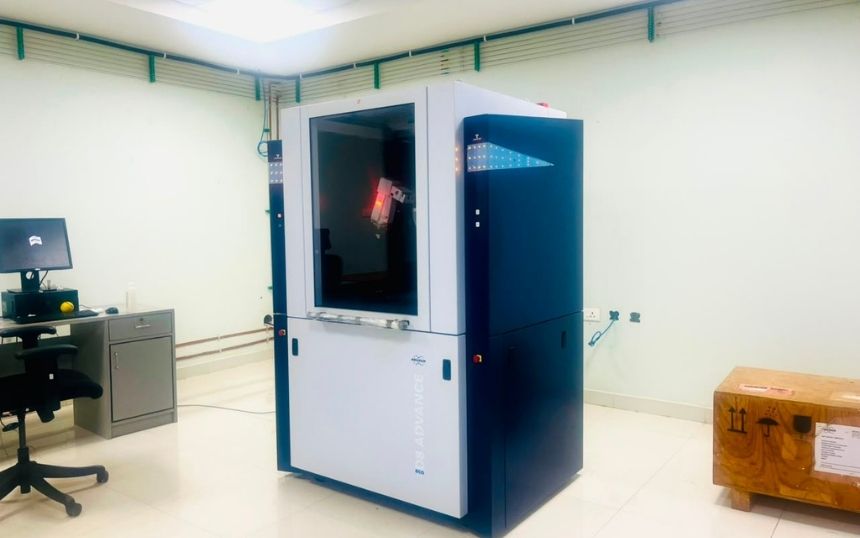

Model Overview.
- Powder X-ray diffraction system
- Radiation Source: Cu-Kα (λ ≈ 1.5406 Å)
- High-precision goniometer
- Operating Power: 1 kW
- High-intensity parallel Kα beam
- 2θ Angular Range: < 1° to > 150°
- High accuracy in peak position: ≤ 0.01° (2θ)
- Suitable for phase identification and structural analysis
- Advanced data acquisition and analysis software
XRD is a non-destructive analytical technique used to identify crystalline phases and determine structural properties of materials.
Key Applications:
Materials Study
- Phase identification and crystal structure analysis
- Crystallinity and amorphous content determination
- Lattice parameter measurement
- Residual stress analysis
Materials Testing
- Quantitative phase analysis
- Grain size and crystallite size estimation (Scherrer analysis)
- Thin film analysis
- Texture and preferred orientation study
Process & Research Applications
- Cement, ceramics, and minerals analysis
- Metallurgical and alloy phase identification
- Nanomaterials characterization
- Pharmaceutical and chemical analysis
The X-Ray Diffractometer (XRD) enables precise identification of crystalline phases and detailed structural analysis of materials. It provides accurate information on crystal structure, phase composition, lattice parameters, and crystallite size. XRD is essential for materials characterization, quality control, and advanced research in physics, chemistry, and materials science.
