

Curabitur non nulla sit amet nisl tempus.
Model Overview.
Atomic Force Microscopy (AFM) is a high-resolution nanoscale characterization technique used to analyze surface morphology, roughness, and material properties. It enables precise imaging and measurement of nanostructures, supporting advanced research in materials science, nanotechnology, and surface engineering.
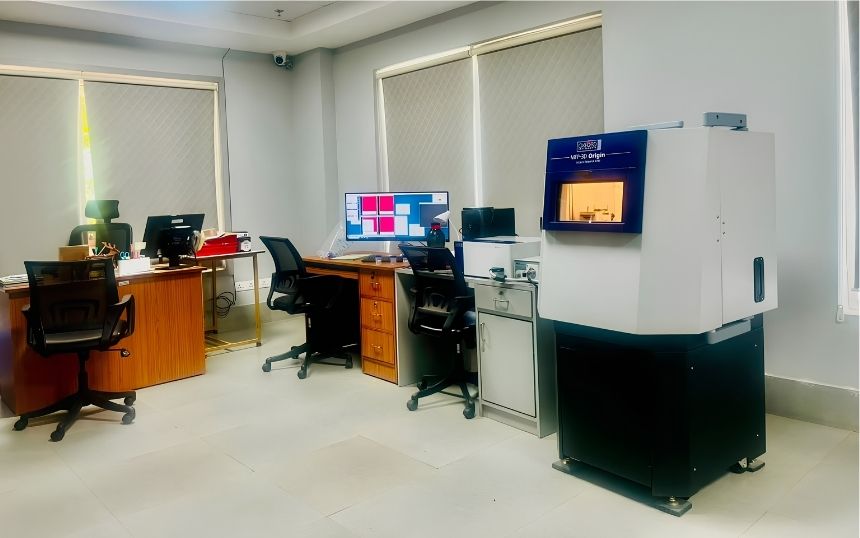

Model Details.
- High-resolution scanning probe microscopy (sub-nanometer resolution)
- Multiple imaging modes: Contact Mode, Non-Contact Mode, Tapping Mode
- XYZ Piezoelectric scanner for precise nanoscale positioning
- Lateral resolution: Depends on tip radius(2nm to10 nm)
- Vertical (Z) resolution: ~0.5 nm
- Scan size: up to 120 µm × 120 µm (XY range) and 15 µm Z range
- Integrated vibration isolation system
- Optical microscope for sample positioning
- Advanced software for image acquisition and analysis
- Force spectroscopy capability
- Phase and amplitude imaging
AFM is an advanced nanoscale characterization technique used to analyze surface morphology, structure, and material properties with extremely high resolution.
Key Applications:
Materials Study
- Surface morphology and topography analysis
- Nanoparticles size and distribution study
- Thin film characterization
- Grain structure and surface defects analysis
- Nanomaterials (Graphene, CNTs, GO, etc.)
Materials Testing
- Surface roughness measurement (Ra, Rq, RMS)
- Mechanical property analysis (stiffness, elasticity, adhesion)
- Phase imaging for material contrast
- Agglomeration and dispersion analysis
- Coating and layer thickness evaluation
Process & Research Applications
- Polymer and composite analysis
- Tribology and wear surface study
- Semiconductor surface characterization
- Biomaterials and vesicle analysis
- Failure analysis at nanoscale
The Atomic Force Microscope (AFM) provides high-resolution 2D and 3D surface imaging at the nanometer scale. It enables precise measurement of surface roughness, particle size, morphology, and material properties such as adhesion, stiffness, and viscoelasticity. AFM is capable of analyzing nanoscale features, evaluating dispersion and agglomeration behavior, and characterizing thin films and coatings with high accuracy.
